Sunday, April 19, 2009

Dr. Strangelove - Strange and In Love with Destruction, Influences Included

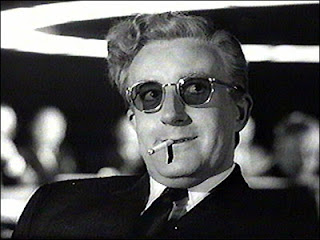
Dr. Strangelove, being the title character of Dr. Strangelove, Or How I Stopped Worrying and Loved the Bomb, is charismatic, ruthless, possibly a Nazi and just downright bizarre. Would you be comfortable with your dentist having a mechanical arm, wearing dark sunglasses, and shouting "SEIG HEIL!" at the wrong moment at the wrong time? I would be yanking myself out of the dentist's chair and checking out with the receptionist knowing none the wiser. Dr. Strangelove is a nuclear physicist whose creation background and character portrayal is inspired by several key historical figures.

According to this site, the German version of Strangelove is "merkwuerdigichliebe," which translates to "cherished fate." The name is significant because given to Dr. Strangelove's demented character, the idea of the whole world going up in nuclear flames would sound immensely appealing. The site also analyzed that director Stanley Kubrick would have chosen historical figures involved in nuclear weaponry and nuclear deterrence to help influence Dr. Strangelove's creation.
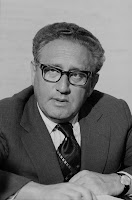
The first would be Henry Kissinger; he was born in Germany, his accent is in synth with Strangelove's and Kissenger's psychology appears to be linked up with a serial killer. Kissenger wrote about nuclear war in terms of nuclear deterrance and a limited nuclear war. It is an irony that a man who won the Nobel Peace Prize would be convicted of war crimes against humanity.

The second person to possibly influence Strangelove's creation is Werner Von Braun, a rocket scientist who worked for the Nazi Party in Germany until the end of World War II. Although Von Braun, according to the same site, was not too concerned with human morals and ethics, he was taken in by the U.S. government to help develop rockets despite the crimes against humanity he may have partaken in while in the Nazi Party. Can a man be easily pardoned becauses he pioneered rocketry for space exploration? Maybe he escaped the death penalty by engineering the surrender of himself other rocket scienitsts.


The third person up Dr. Strangelove's creation alley would have to be Edward Teller. This Hungarian scientist is infamous to helping to revoke J. Robert Oppenheimer's security clearance to Los Alamos base, the same base where the first atomic bomb was developed. Teller was a pro-nuclear weapons enthusiast and helped develop the more powerful hydrogen bomb.

The last person to be analyzed would be Herman Kahn. His development for nuclear weapons were more linguistic than most. An example of his linguistic skills would be saying that "only" two million were killed by nuclear weapons. Kahn worked with the RAND corporation, a corporation that was the creation of the Air Force. Kahn's corporate
background is similiar to Dr. Strangelove's partnership with the BLAND corporation.
Looking at these four men related to nuclear warfare and nuclear weapons production, I would have to say these men would be the "Four Scientists of the Apocalypse." You have the strategist, the technologist, the manipulator, and the double-speaker. They were lauded for achievements such as space exploration and diplomacy but they are loathed for supporting genocidal regimes and engineering weapons of mass destruction.

So, what about Dr. Strangelove's mechanical arm? The character's arm may be inspired by Dr. C. A. Rotwang, the mad scientist featured in Fritz Lang's Metropolis who wrecked havoc for everyone in sight. Many critics have made comparisons between Rotwang and Dr. Strangelove, but Kubrick has denied any similiarities. Both are mad scientists, though Rotwang is the guy responsible for the "mad scientist character." Dr. Strangelove can be called a "mad scientist" but he appears to be more of a crook skilled in manipulation, nuclear theory and weirdness.
Dr. Strangelove is a highly memorable character from Kubrick's excellent dark comedy. He is cold, calculating, and is bad news to anyone's war room.
- Kristopher

Tuesday, April 14, 2009

Invaders from Cards

The movie we saw last week, Mars Attacks, was based on a series of trading cards that beared some resemblances to the movie. The cards themselves are less satirical than the movie's story but they are twice as violent and packing more sexual innuedoes than the movie ever dared to venture to.

So yes, I could not help but make comparisons to the movie and the original trading card source. Yet there are so many simliarities and differences when you consider the Martians vaporizing hapless humans into multicolored skeletons, shrinking soldiers into pint-sized victims and Maritians in giant robots running amok! There is also another gruesome weapon the Martians employ in the cards; giant bugs that are enlarged thanks to their gruesome experiments. And yes, there is a ton of nasty stuff like that...

You can find more information about the cards here.

- Kristopher

Monday, April 6, 2009

Cowboy Bebop - Anime Space Opera or "Space Jazz?"

It just occurred to me lately that as I delve into the space opera realm, I think of my favorite Japanese anime that takes place in the space opera realm. Enter Cowboy Bebop, an anime set in the 2070s after Earth became bombarded from an "interstellar disaster." The anime features three main bounty hunters-ex-Mafioso Spike Spiegel, ex-cop Jet Black and gambler Faye Valentine-and the self-proclaimed Edward Wong Hau Pepelu Tivrusky IV, A.K.A. Edward who is usually accompanied with Ein, a dog with unusually high intelligence who travel in the ship, the Bebop.

The bounty hunters embark on adventures--or misadventures--across the solar system looking for criminals whom the police cannot capture on their own. There's action, comedy, philosophy, tragedy and animation that's better than most of the current anime lineup coming out. For those unfamiliar with anime, Cowboy Bebop is a great place to start because the series is chock full of Western pop culture references from movies to music.

How is this anime related to space opera? Aside from taking place mostly in space, the crew of the Bebop travel to the ruins of Earth, cities on Mars, and other far off places. Cowboy Bebop can be accurately classified as a "space western." The primary weapon shown in most of the episodes is the handgun, a type of firearm featured heavily in Westerns. The theme of bounty hunters catching their bounty heads in space can also be applied for bounty hunters stalking their quarry across the desert in a Western. Space, according to "The Cold Equations," is a dangerous frontier and this theme is highly apparent in the Cowboy Bebop series.

Below is the trailer for Cowboy Bebop: The Movie, a full length motion picture that features a story set within the main Cowboy Bebop storyline. The movie was the reason I got into the series in the first place. I read a few reviews of people who have never seen the twenty-six episode series but loved the movie with a passion.


- Kristopher

Wednesday, April 1, 2009

Dark Star Equals "Dork Star?"


When do you get when you have a pre-Thing and Escape from New York John Carpenter, intentionally(?) low production values, a bunch of hippies in space suits, a beach ball that's actually an alien and a bomb that can get philisophical? Ladies and gentlemen, you get Dark Star. This movie is so ridiculously corny that even the name of the movie is painted on the hull of the ship!

Part of me could not decide whether this movie was mildly funny or completely stupid but when the movie ended, I could not end up shaking my head in disbelief of well, the crazy things that happened in a movie where the crew is distressed because their entire supply of toilet paper went with a bomb they used to blow up a planet with.

The whole "blowing up planets" concept baffled me at first; why would a ship blow up random worlds? The movie could be a satire of how countries can casually bomb each other, and the people responsible for the bombs aren't highly trained professionals. They are clueless followers of the Beatles, or clueless impersonaters of the Beatles, whatever the viewer wanted to make out. Dark Star is, clearly enough, a spoof of the space opera because its crew is not valiant; all they want to do is sit around, read romance magazines, play target practice with laser guns and not have to deal with the "beach ball" alien who loves to bash the crew with a broom back and strand them in an elevator shaft (One of the crew members, Pinback, is one of the more disgruntled of the crewmembers that has to contend with a diary system that edits "obscene" words and gestures.).

Possibly the most interesting and funniest scenes involves one of the crew members, Doolittle, trying to talk to a bomb about not exploding. Doolittle tries to talk to the bomb about not exploding using existential philosophy; why should the bomb explode? Why should it not explode? The bomb is "spaced out" as it contemplates why it should exist and why it should not detonate. Could the same philosophy be applied to today's nuclear weaponry? I know we are a long way's off from the "apocalyptic scenario" discussed earlier in class but the space bomb may be a satire of the nuclear bomb. Humans do not usually "talk" to bombs but rather take them for granted and used them to blow up for pleasure and practicality.

The same philosophy used on the bomb could be used on the people responsible for pressing the red button for a nuclear weapon, a set of cluster bombs or a "bunker buster." Why do we explode? Why do we blow stuff up? The movie implies we just do to see something burst into a watercolor painting of napalm and charred chunks flying (or floating) all over the place.

Coming to think of it, people usually say violence in real life is not a good idea but then we enjoy movies like The Terminator, anime and manga like Hellsing that glorifies itself in dark humor and bloodshed and video games like Devil May Cry that congratulates the player on killing monsters in a fantastic fashion. Is Dark Star a satire of destruction, or does it just poke fun as "space opera" elements without regarding to deeper meanings?

Considering how "spaced out" the movie is (According to the poster at the beginning of this post), I would say we should not care what the movie is trying to tell us. Beach ball aliens and talking bombs just do not make any sense. Till then, surf's up!

- Kristopher

Thursday, March 26, 2009

The Hugo Award

The Hugo Award can be described as a science fiction Oscar of sorts. The group responsible for presenting the Hugo Award is the World Science Fiction Society. The earliest Hugos were awarded in 1953. Among the winners of the Hugo Award, one of the most famous is the graphic novel Watchmen, which was recently made into a motion picture not too long ago.

The categories that get rewarded are Novel, Novella, Novelette, Short Story, Related Book, Dramatic Presentation (Long Form), Dramatic Presentation (Short Form), Professional Editor, (Short Form), Professional Editor, (Long Form), Professional Artist, Semiprozine, Fanzine, Fan Writer, and Fan Artist. For a list of the 2008 winners, click on this link.

- Kristopher

Thursday, March 19, 2009

2001: A Well Made Albeit Trippy Odyssey

Let me tell you, it was quite an odyssey.

I was one of those naive viewers who never glimpsed Stanley Kubrick's 2001: A Space Odyssey in its trippy, deeply philisophical grandeur. I took in the amazing special effects, still impressive after 1968! Despite the minimal dialogue, I could feel the tensity and grandeur of spacecraft traveling in the moon, the hopelessness on an AI controlled ship and the twisted horror of the final sequence that involves eighteenth century decor. "What?" I asked myself. "Eighteenth century decor? What is this movie anyway?"

Actually, that's how I was throughout the whole movie: I kept asking "What's going on? What's with the apes and the monolith?" I knew the "past" was shown first to show evolution of humankind but it was pretty ambigious nonetheless. It was the same for the mission on the moon, where another monolith was found. Then the trip to Jupiter...I will die knowing that there is a movie that will make me reflect on these twisted images for years to come. 2001: A Space Odyssey is a movie that will haunt me to a point where I need to see it again. So Kubrick's science fiction adventure was, well, almost near impossible to comprehend with the mysterious mode of direction that was used. And yet, perhaps the movie was not made to stand by itself. Enter Arthur C. Clarke, the man who helped write the screenplay with Kubrick and wrote the novel version of 2001: A Space Odyssey. The novel, according to this review by Steven Silver, the novel helps explain the events going on in the movie even though it may only be 90% compatible with the movie. For one thing, the novel version depicts Dr. David Bowman and his crew traveling to Saturn as opposed to Jupiter. I have not read the novel but I will certainly have to pick up it sometime soon.

I usually have some interpretive commentary about what I have seen or read. My best guess about the movie (and other comments I read on the Internet) is that the primary theme is evolution. We see humanity as just a bunch of savage apes eating, growling and fighting amongst one another. Then a giant black stone slab comes down to earth and truly sends the apes into a frenzy. Thousands of years later, humanity goes into space and even a major airline company that exists in the real world gets its own space ship line up. On the moon, where no one would expect nothing but a pitted surface made of chalk, another monolith appears. The "evolution" of this action has us focus a few years later on David and his crew, watched over by a highly intelligent and articulate AI complex named HAL.

HAL may think higher than a human being but may be an antagonist towards human evolution; technology benefits us in many ways but it can destroy us in many ways as well. Why would the atomic bomb be glorified? The device is one technological achievement of humans that would ultimately destroy us. HAL, designed to benefit humankind, turns against its human crew. David succeeds in dismantling HAL and proceeds onto the next stage of evolution; a transcension beyond, time, space and even body!

2001: A Space Odyssey will haunt my psyche for years to come. I'll imagine that I will watch it seventy times and still not get the full picture! Kubrick was awesome for A Clockwork Orange and Dr. Strangelove but his props for weirdness in the sci-fi realm tops off all the films he created during his lifetime.


- Kristopher

Friday, March 13, 2009

What is Space Opera?


My class will be veering away from the apocalyptic landscape and into the realm of space with movies such as 2001: A Space Odyssey. We will be exploring space opera, a field that brings to mind interstellar adventures, ray guns, alien creatures and space ships, lots and lots of spaceships.

When people do look up the term "space opera" and are not science fiction enthusiasts, the usual remarks are "Is it something Star Wars related?" or "I'm sorry, I don't speak Klingon."

"Space opera" was first developed by E.E. "Doc" Smith, one of the originators of the modern science fiction tale. The space opera continued to thrive through the "Golden Age of Science Fiction" that was featured from the 1930s to the early 1940s. The more sophisticated type of space opera emerged with Isaac Asimov's Foundation series. Frank Herbert came along for the ride with Dune, a novel that although for the most part was set on the desert planet of Arrakis, it carried many space operatic traits such as battles and events taking place on a large scale. TV featured Gene Roddenberry's Star Trek, George Lucas had Star Wars for the big screen, and more media for space opera kept coming with shows like Babylon 5, and role playing games like Travler. The realm of video games is chock full of space opera, with Bioware's Mass Effect, Blizzard Entertainment's StarCraft and Bungie's Halo as prime examples. They all feature characters or a group of characters who traverse a planet or a set of planets (or just across the void of space) while battling enemies in form of corrupt empires, parasitic life forms and other antagonistic elements.

Space opera is not deemed "space opera" for nothing because there is usually a large adventure involved with two or more forces clashing with one another. Classic space opera was usually pretty straightforward, taking place in the future with humanity colonizing other worlds outside their galaxy. There are ships that can go faster than the speed of light and alien races that almost always resemble humans and are usually at the same level in terms of technology and even language. The different planets of space opera resemble different countries, with different races resembling different nationalities. Space opera is less about the future and more about the past and present, with intergalatic wars resembling the real worlds Earth has had during the past two centuries, especially World War II.

Here is a link that outlines the history of space opera, because space opera can only fit so much into one post. There are different genres of science fiction that are encompassed with space opera, such as military science fiction, planetary romance and even space westerns. The Internet is a big universe in itself and sometimes the best way to analyze information is to read through all of it. That in itself is a big adventure!


- Kristopher